Tim Davie on the importance of trust in the BBC and the corporation reflecting society
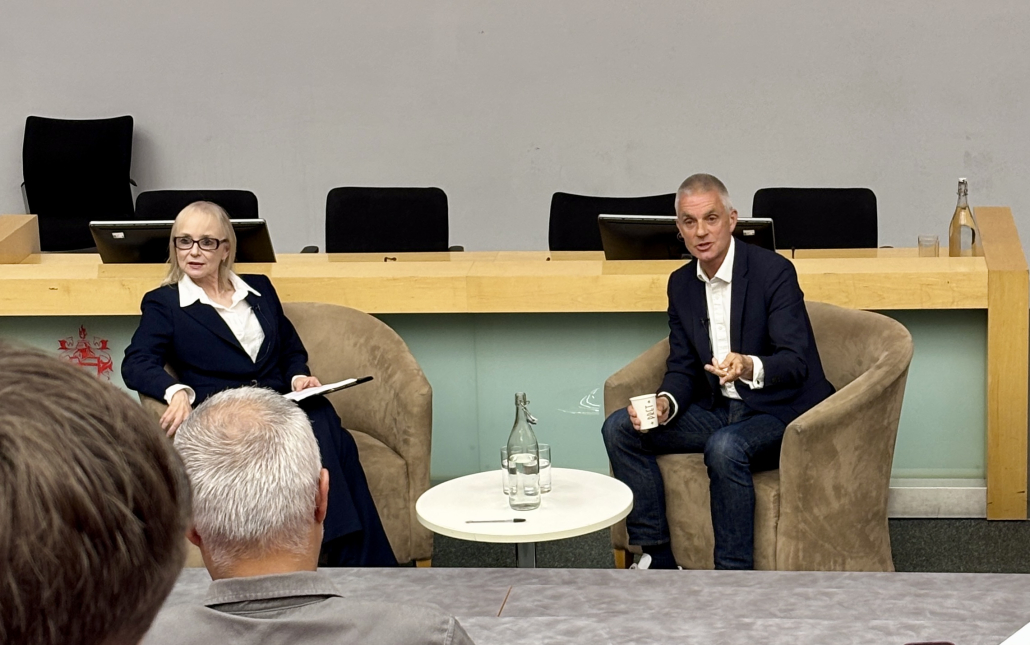
Trust, curiosity and adapting to changes in both society and media usage were the key themes of the BBC Director-General Tim Davie’s chat to students and staff at City St George’s University yesterday.
It was fascinating to hear him in person – it was so much better than just reading the transcript of his recent speech on the future of the BBC. As a visiting lecturer on the uni’s MA Broadcast Journalism course, proudly assisting students on their digital and social media newsdays, I was lucky to attend this event.
Through a discussion of a wide range of topics, the audience developed a great insight into one of the most high profile and scrutinised people in the country, and also what other public institutions can learn from his approach to rebuilding trust in the organisation.
‘Impartiality is my number one priority’
Tim Davie repeatedly stressed the importance of trust in the BBC and maintaining its impartiality in its news coverage – and how “trusted content is beyond news.”
As we’ve seen in recent times, it’s never been more vital. He noted how “we’re seeing a wholescale degradation in the free press” around the world – from sniping on social media to journalists having access barred to outright censorship.
In the UK, we’ve seen a decline in faith in public institutions and figures, as well as in the media. We have seen regular claims of bias in the BBC’s reporting, especially around the conflict in Gaza, and an increase in polarisation – or greater visibility of strong views on issues through social media.
Davie talked how “deeply passionate I am” about trust, and that “impartiality is my number one priority”, warning of the risks “if you can’t be trusted.”
Pointing to how the BBC has increased its trust amongst the British public, he proclaimed that “what drives me every day is fair and balanced coverage”, particularly in such a polarised and fragmented environment.
One of the criticisms of BBC News has been around prioritising balancing a range of views on an story, even when the facts were clear. Davie insisted that “we believe in facts, not ‘my truth’.”
Responding to a question alleging different sets of standards for top broadcasters on expressing personal views, compared to their colleagues in news, he said "not on my watch", adding that disciplinary investigations had taken place if there had been instances. He said that staff weren't allowed to wear items symbolising support for a country, or a campaign, including Black Lives Matter, to maintain standards of impartiality.
'The biggest danger is institutions drifting away from society'
The BBC has been strongly criticised by campaigners and opposing politicians for the amount of coverage and airtime that it had given Reform - further stoked by a report on Byline Times yesterday highlighting discussions in a BBC editorial standards committee meeting about addressing low levels of trust in the organisation among Reform voters.
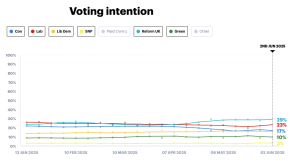
Reform have 5 MPs, and according to YouGov's tracker of voting intentions over the past six months, Nigel Farage's party is ahead of the other parties - though of course, this could change by the next general election.
Hitting back at critics, Tim Davie defended the BBC's approach of giving airtime to other political parties, saying "I'm here to serve everyone; I don't sneer", though he said he made exceptions for those with "extreme or violent" values.
He explained how the BBC "need[s] to reflect the society we serve" and that "society is changing", also dismissing views that claimed particular popular topics or issues "are woke". He warned how "the biggest danger is institutions drifting away from society", presumably because people then feel they don't reflect their needs, interests and concerns.
The minutes of the aforementioned meeting in March, which Davie attended, are available on the BBC's website. They record Deborah Turness, the chief executive of news and current affairs, presenting plans on "address[ing] low trust issues with Reform voters" and how the committee "recognised the importance of local BBC teams in the plan, given their closeness to audiences" and "discussed how story selection and other types of output, such as drama, also had a role to play."
This review seems to align with his aim of the BBC listening to its audience and reflecting society, and ultimately rebuilding trust in the BBC.
It's not just its output that needs to adapt to society, but the BBC's makeup too. Davie said "the biggest challenge in the BBC is socio-economic", and how its staff needed to better reflect the country. He highlighted the standard measure of recording the socio-economic background of employees (the occupation of the highest earner in their household when someone was 14), saying within the media industry it was at 15%, with the BBC at 20%, but within the UK it is 30%.
He seemed proud that you could now be a network news editor, a role recently limited to London and Manchester, "anywhere in the country", after the BBC moved most of its programming and roles outside of London.
Adapting to how audiences watch, listen and read news and entertainment
Tim Davie was clear that "you've got to hold your nerve" as a public sector broadcaster, insisting "we are just not chasing popularity and clicks."
But that doesn't mean on-air staff have to be boring. "Our best editors are entertaining", he said, namechecking political editor Chris Mason and Moscow editor Steve Rosenberg.
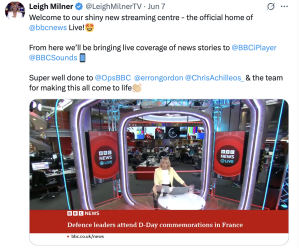
In his major speech last month, Davie said, "We have been working hard to build digital platforms and content to meet changing audience needs... The BBC can play a key role in innovating to ensure that the new world is inclusive and accessible." For example, just last week it launched BBC News Live streaming centre.
Pointing out how "we're innovating all the time", he said he didn't want PSB "to be trapped by format", explaining that "I think the BBC can do a really good 90 second update [on a story] - and if you want to read more, read our in-depth article" or the possibility of using AI to summarise that morning's Today programme.
And on personalisation, he said more could be done, but there was a balance in needing the expert guidance from journalists on the most important stories nationally. "We should be trying to being people together, not forcing them into their own echo chambers", he said.
He also made clear that the PSB remit shouldn't be a straitjacket, and how under his leadership, the BBC manages resources with audience value: "I don't believe in market failure - doing something 'because we should'."
Value was a term mentioned a lot, including "how do we offer unique value" in an era of infinite choice and "how do we make high value subjects popular?" He pointed to its distinct news offering and Sir David Attenborough's talents as responses to those two questions.
However, when questioned by someone who didn't pay the licence fee, he revealed that "a lot of our future is about building trust" in the BBC, saying the issues were "largely about usage."
Davie's 'purpose-driven' role
As a former public servant, working in comms in the Civil Service, I was struck by Tim Davie's passion for his "purpose-driven" role as BBC Director-General, and how "there's no substitute for actually caring about something." It feels that more public institutions could tap into this culture for their recruitment and retention strategies.
Similarly, he was also clear on the key qualities he looks for when hiring, such as "knowing you're serving the public" and "listening hard" to the audience, having an "open mind", and the importance of strong teamwork skills.
But his biggest piece of advice to his three sons? "Be decent, is by far the most important. Don't be a prat."
Trackbacks & Pingbacks
[…] Tim Davie on the importance of trust in the BBC and the corporation reflecting society […]
Comments are closed.