Tag Archive for: BBC News

Don’t overlook local news

We know the popularity of linear TV (ie what’s broadcast on a channel) is in a sharp decline – but I was interested to see how the BBC’s 6.30pm regional news programme was the most watched TV show for three consecutive days last week.

@LiamHamilton16 'Three in a row' fj'....Every day this week so far BBC regional news at 6.30 has been the most watched programme on tv with 3.8m viewers on Monday, 4m on Tuesday & 3.8m again last night. Biggest non-news audience, either Corrie or Emmerdale on ITV1 with a consistent 2.8m 11:14 • 29/01/2026 •

Thanks, as ever, to TV journalist Liam Hamilton for sharing these insights! Follow him on Twitter/X here.

This isn’t the first time it’s happened recently – Liam reported that BBC1’s biggest TV audience on Christmas Eve was for…the regional news bulletin!

Strange but true….biggest audience on BBC1 on Christmas Eve was for a 10 minute regional news bulletin which attracted a little under 2million viewers at 5.20pm, just pipping Eastenders, 1.9m, & Paddington, 1.8m for bragging rights as the channels biggest audience of the day. 9:58 PM · Dec 25, 2025

And it happened again a couple of weeks earlier, too:

Ex-News, no programme on BBC1 attracted more than 2m viewers on Tuesday while the most watched programme across all channels was a repeat of The Chase on ITV with 2.6m. Including news programming, the regional news at 6.30 on BBC1 was biggest audience of the day, 3.5m. Good day also for news programming early morning on the big two channels with BBC Breakfast (44%, 1.2m) & Good Morning Britain on ITV1 (23%, 600k) securing over two thirds of all viewing between them in the day part. Not seen higher in a very long time. 👏

This is not to paint a rosy picture of news bulletins on linear TV – it is facing the same struggles as the rest of the broadcast output.

Recently, STV chief executive Rufus Radcliffe revealed that its flagship STV News at Six, the most watched regional news programme in Scotland, is “down over 20% year on year and is projected to reduce by over 40% by 2030.”

But there are signs that local news matters more than ever to people – but there are now so many more ways for us to keep up with it in a way we want, and when we want.

A rocky time for long-standing regional newsbrands

The number of us reading local news from commercial publishers has grown by 7% year-on-year, according to the latest Ipsos Iris figures shared by Behind Local News, up to 35.6 million.

It says that means 67% of the UK population is reading local news every month, though that figure drops for younger readers, with 38% of 18-24 year olds and 54% of 25-34s.

But page views are falling very significantly. Hold The Front Page reported that December’s stats “showed an overall year-on-year decline in page views of 27%, although the overall audience for the sector fell by just 0.46%.”

Table showing top regional newsbrands by overall audience (unique users) in Dec 2025

These tables are from Hold The Front Page – you can see the rankings in their entirety on its website.

Table showing top regional newsbrands by page views in Dec 2025

This is coupled with the continuing decline of print, with Press Gazette reporting last September that “regional daily newspaper sales fell by an average of 18% in the first half of 2025 with just one title (the Belfast-based Irish News) above 20,000 copies per day.”

This makes sense why Reach continues to expand its ‘premium subscriptions’ for its regional titles online, with the latest being the Daily Record and Leicestershire Live.

But the latest stats I can find (from last September) appear to show that it’s hard for previously paper-focused brands to match their print subs, with the Irish News topping the table with only 3,450.

Local newsletters are thriving

London Centric homepage on Substack

London Centric’s homepage on Substack could look pretty much like any news site on a desktop browser

Spotting big gaps in the market for original, distinctive and engaging local news, start-ups like The Mill and London Centric, which use slick-looking but easy to manage newsletter platforms like Substack and Ghost, have proven to be very successful – and continue to do so.

London Centric now has nearly 35,000 subscribers – with over 10% being paid, according to a Journalism UK interview with founder Jim Waterson in November. If you remember that the Irish News’ digital subs were at 3,450 at the latest official recording, that’s seriously impressive for a publication set up 18 months ago.

“I have to fight for every reader and bring people in, but once you’ve got them on that newsletter, people say they trust me”, Jim says.

It’s not just his focus on very sharable scoops and human stories, but how he writes them: “Journalism can be very pious and I believe in it so much, but you’ve got to have a bit of joy”.

Newsletters allow you to geek out with your niches too, such as former Reach journo Will Hayward’s on Welsh politics, with nearly 10,000 subscribers (I even have one about milestone anniversaries of memorable moments in wrestling history, which is a lot less successful!)


Nextdoor isn’t all about online arguments

There are now said to be 10 million people on Nextdoor – around one in four adults – but given that figure was from September 2024, that’s likely to have risen.

Yes, it can resemble your road’s WhatsApp chat at time with complaints, rows and the odd bad joke, but it is also a great way to share and gather local news. There are over 80,000 local groups based on fostering a sense of community and togetherness, or to discuss your passionate interests – and public bodies from No10 to councils and environment agencies see it as an effective communication tool.

Last year, it launched partnerships with local publications including the Kent Messenger and Grantham Journal and invited others to join – but we haven’t heard much, if anything, since about other titles (but I can see that my local news site is now on my ‘local news’ feed, which closely resembles a cross between Facebook and Nextdoor.)

Nextdoor local news publisher

What’s up with WhatsApp?

After the initial surge of excitement about the new shiny thing (*cough*, yep) was replaced by annoyance, with a constant bombardment of lazy link posts, a lot of publishers and readers have gone off WhatsApp Channels.

It seems from a quick scan that no regional paper has broken past 150,000 followers (and who knows how many are still active on those channels and reading those messages, let alone tapping through…)

But where there was failure is now hope. Rather than following the old style of news publisher route, local outlets appear to be enjoying more success through diversifying into smaller niche interest channels.

Take the Liverpool Echo, owned by Reach. Their bespoke channels on Liverpool FC (which includes Liverpool.com) are far more popular than the main account.

Liverpool FC WhatsApp channels

Again, it seems to make sense to me as a reader as I tend to want news that I know I will care about – think about when someone posts something in the group chat about a story or issue you have no interest in; are you going to bother to tap through, or zoom in, to read, let alone watch?

(Yes, my friends have told me when they don’t care about me constantly sending irrelevant tweets or TikToks…)

The enduring popularity of Facebook Groups

Tldr: it’s an oldie but a goodie.

Just take public sector comms consultant Dan Slee’s research from last July, entitled ‘The continued rise of Facebook groups in 2025’. He gives an example of Braintree in Essex, which has around 155,000 residents:

The number of Facebook groups in Braintree, Essex is increasing again

There are almost 600 Facebook groups of nearly every kind of niche and interest for those who live there. Dan says, “If you are a nerd about this, all this means that are roughly 5.5 Facebook group memberships per head of population.”

bar chart show increasing rise in Facebook group membership in Braintee, Essex after peaking during the pandemic

Social is a popular source of local news

Ofcom research last summer appeared to show that Facebook groups and other social media are still major source of local news and information.

The top individual services of local news and information in 2025 are the BBC website or app (37%),regional news bulletins on BBC One (35%) and local groups or accounts on social media (34%). Ofcom, 2025

Ofcom’s News Consumption in the UK 2025

This is where the incredible world of independent content creators has developed – similar to the newsletter guys, they have exploded in popularity by focusing on specific themes or issues and match it with very simple, powerful, and engaging storytelling and building powerful communities of loyal audiences.

One of my favourites at this is Zoë Bread, who brilliantly detailed her battle with Manchester City Council over a confusing parking ticket machine sign – a fantastic piece of investigative reporting. Her Instagram has been taken down for some reason, but she is still on TikTok.

However, those surveyed by Ofcom admitted they generally don’t see social media as reliable or as trustworthy as other forms of communication. But interestingly, they are more likely to believe posts on  neighbourhood apps like Nextdoor:

Perceptions of trustworthiness of local news and information by service, Ofcom survey 2025. Trust and accuracy are also considered important attributes for local news on traditional platforms such as TV, radio and print newspapers by nine in ten users. These traditional services are all generally seen as trustworthy and accurate by 80-90% of users. Local news on social media or video sharing apps are rated less highly, with 60-70% of users seeing them as trustworthy and accurate. Word of mouth, while a key avenue for people hearing about local news and information, is perceived as the least trustworthy method of getting local news and information.

The final fascinating point from this Ofcom report is that adults in Scotland are more likely to use social media for news compared to the UK (57% to 51%). But adults in Northern Ireland are much less likely (46%).

What about YouTube and podcasts?

A lot has been written about the rise in popularity in podcasts, both in visualised and audio form, and how YouTube is by far the biggest streaming service in our TVs and also in terms of digital and social platforms.

But a great example of how local news organisations are adapting to these changes is a documentary by ITV Central called Decoy, which reunited the brave female undercover officers who trapped one of Britain’s most-wanted men in 1979 – and whose footage was instrumental in the killer’s re-arrest in 2022.

ITVX listing for Decoy

I had the pleasure of watching this for the RTS news awards in 2023 and not only was I captivated by the story, but admired the thinking behind its approach to production.

It was created for YouTube and what was then the ITV Hub, but it was later broadcast on their flagship evening bulletin, but broken down into five chapters, and shown each day over a week. It was also initially designed to work as a podcast too.

The number of people who viewed it at 6pm was dwarfed by the huge numbers who streamed it.

Rather than just attempting to get viewers to watch just a wide range of TV packages online, ITV Central were focusing here on the popular longform topic of crime, but combining it with strong, distinctive and human-centred storytelling.

It’s a similar approach that both the BBC and commercial radio has followed. Global and Bauer have led the way with their podcasts and video offerings, even as commercial radio continues to enjoy an incredible record number of listeners to its stations (I have suggested why those in comms should be harnessing the power of commercial radio here.)

What does this all mean?

Is it due to the crazy, confusing and increasingly frightening world we live in, which is then reflected in the national news agenda, that pushes us more to what is going on closer to home?

Or our preference to indulge in our passions with like-minded people and the platforms that allow us to it from our phones?

Or the ability to watch information and entertainment when and where we want to? Or that appointment to view TV now only matters when it brings audiences together for big cultural moments?

Or all of them?

I think it depends on your demographic – but what is true is that the media landscape is more fragmented, niche-based, and changing quicker than ever before.

It does mean there are fantastic opportunities for communicators to spread tailored and focused messages to target local audiences, and for agile digital-first start-ups to tap into gaps in the market and provide trusted and accurate regional reporting of potentially underreported issues.

But this also means a challenging time for publishers with historic media legacies – and some are adapting and equipping themselves better than others.
 

Tim Davie on the importance of trust in the BBC and the corporation reflecting society

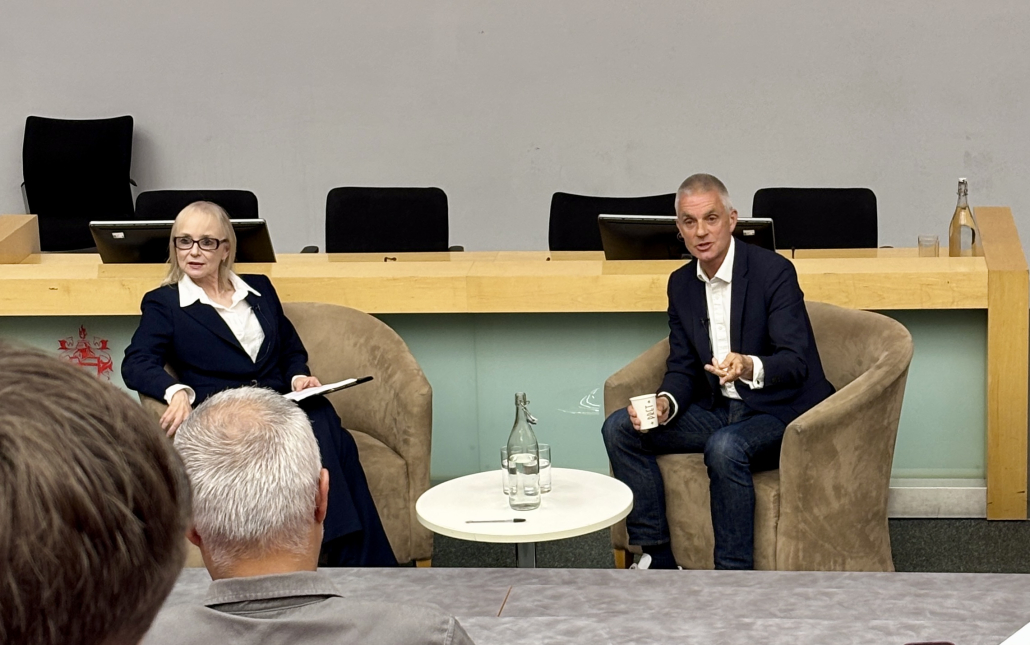
Tim Davie and Juliet John talking to students and staff at City University

Trust, curiosity and adapting to changes in both society and media usage were the key themes of the BBC Director-General Tim Davie’s chat to students and staff at City St George’s University yesterday.

It was fascinating to hear him in person – it was so much better than just reading the transcript of his recent speech on the future of the BBC. As a visiting lecturer on the uni’s MA Broadcast Journalism course, proudly assisting students on their digital and social media newsdays, I was lucky to attend this event.

Through a discussion of a wide range of topics, the audience developed a great insight into one of the most high profile and scrutinised people in the country, and also what other public institutions can learn from his approach to rebuilding trust in the organisation.

‘Impartiality is my number one priority’

Tim Davie repeatedly stressed the importance of trust in the BBC and maintaining its impartiality in its news coverage – and how “trusted content is beyond news.”

As we’ve seen in recent times, it’s never been more vital. He noted how “we’re seeing a wholescale degradation in the free press” around the world – from sniping on social media to journalists having access barred to outright censorship.

In the UK, we’ve seen a decline in faith in public institutions and figures, as well as in the media. We have seen regular claims of bias in the BBC’s reporting, especially around the conflict in Gaza, and an increase in polarisation – or greater visibility of strong views on issues through social media.

Davie talked how “deeply passionate I am” about trust, and that “impartiality is my number one priority”, warning of the risks “if you can’t be trusted.”

Pointing to how the BBC has increased its trust amongst the British public, he proclaimed that “what drives me every day is fair and balanced coverage”, particularly in such a polarised and fragmented environment.

One of the criticisms of BBC News has been around prioritising balancing a range of views on an story, even when the facts were clear. Davie insisted that “we believe in facts, not ‘my truth’.”

Responding to a question alleging different sets of standards for top broadcasters on expressing personal views, compared to their colleagues in news, he said "not on my watch", adding that disciplinary investigations had taken place if there had been instances. He said that staff weren't allowed to wear items symbolising support for a country, or a campaign, including Black Lives Matter, to maintain standards of impartiality.

'The biggest danger is institutions drifting away from society'

The BBC has been strongly criticised by campaigners and opposing politicians for the amount of coverage and airtime that it had given Reform - further stoked by a report on Byline Times yesterday highlighting discussions in a BBC editorial standards committee meeting about addressing low levels of trust in the organisation among Reform voters.

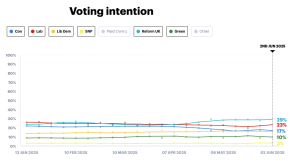
Reform have 5 MPs, and according to YouGov's tracker of voting intentions over the past six months, Nigel Farage's party is ahead of the other parties - though of course, this could change by the next general election.

Graph of voting intentions trackign changes from January 2025-to date. It shows Reform ahead on 29%, with Labour on 23% and the Conservatives on 17%

Hitting back at critics, Tim Davie defended the BBC's approach of giving airtime to other political parties, saying "I'm here to serve everyone; I don't sneer", though he said he made exceptions for those with "extreme or violent" values.

He explained how the BBC "need[s] to reflect the society we serve" and that "society is changing", also dismissing views that claimed particular popular topics or issues "are woke". He warned how "the biggest danger is institutions drifting away from society", presumably because people then feel they don't reflect their needs, interests and concerns.

The minutes of the aforementioned meeting in March, which Davie attended, are available on the BBC's website. They record Deborah Turness, the chief executive of news and current affairs, presenting plans on "address[ing] low trust issues with Reform voters" and how the committee "recognised the importance of local BBC teams in the plan, given their closeness to audiences" and "discussed how story selection and other types of output, such as drama, also had a role to play."

This review seems to align with his aim of the BBC listening to its audience and reflecting society, and ultimately rebuilding trust in the BBC.

It's not just its output that needs to adapt to society, but the BBC's makeup too. Davie said "the biggest challenge in the BBC is socio-economic", and how its staff needed to better reflect the country. He highlighted the standard measure of recording the socio-economic background of employees (the occupation of the highest earner in their household when someone was 14), saying within the media industry it was at 15%, with the BBC at 20%, but within the UK it is 30%.

He seemed proud that you could now be a network news editor, a role recently limited to London and Manchester, "anywhere in the country", after the BBC moved most of its programming and roles outside of London.

Adapting to how audiences watch, listen and read news and entertainment

Tim Davie was clear that "you've got to hold your nerve" as a public sector broadcaster, insisting "we are just not chasing popularity and clicks."

But that doesn't mean on-air staff have to be boring. "Our best editors are entertaining", he said, namechecking political editor Chris Mason and Moscow editor Steve Rosenberg.

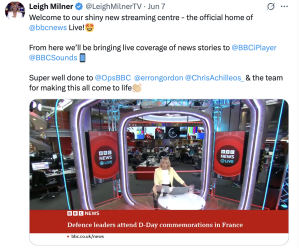
Leigh Miller tweet showcasing BBC News Live

In his major speech last month, Davie said, "We have been working hard to build digital platforms and content to meet changing audience needs... The BBC can play a key role in innovating to ensure that the new world is inclusive and accessible." For example, just last week it launched BBC News Live streaming centre.

Pointing out how "we're innovating all the time", he said he didn't want PSB "to be trapped by format", explaining that "I think the BBC can do a really good 90 second update [on a story] - and if you want to read more, read our in-depth article" or the possibility of using AI to summarise that morning's Today programme.

And on personalisation, he said more could be done, but there was a balance in needing the expert guidance from journalists on the most important stories nationally. "We should be trying to being people together, not forcing them into their own echo chambers", he said.

He also made clear that the PSB remit shouldn't be a straitjacket, and how under his leadership, the BBC manages resources with audience value: "I don't believe in market failure - doing something 'because we should'."

Value was a term mentioned a lot, including "how do we offer unique value" in an era of infinite choice and "how do we make high value subjects popular?" He pointed to its distinct news offering and Sir David Attenborough's talents as responses to those two questions.

However, when questioned by someone who didn't pay the licence fee, he revealed that "a lot of our future is about building trust" in the BBC, saying the issues were "largely about usage."

Davie's 'purpose-driven' role

As a former public servant, working in comms in the Civil Service, I was struck by Tim Davie's passion for his "purpose-driven" role as BBC Director-General, and how "there's no substitute for actually caring about something." It feels that more public institutions could tap into this culture for their recruitment and retention strategies.

Similarly, he was also clear on the key qualities he looks for when hiring, such as "knowing you're serving the public" and "listening hard" to the audience, having an "open mind", and the importance of strong teamwork skills.

But his biggest piece of advice to his three sons? "Be decent, is by far the most important. Don't be a prat."